Saturday, March 4, 2017

Chugoku Sanyo, San-in 中国地方山陽、山陰 - Mansuirou 万翠楼

Stayed 19.04.2015 (1 night)
Reserved thru' Jalan.net.
3 pax/room with half board = 47,430 yen; inclusive of 150 yen/pax (bathing tax)

Mansuirou, seen from Misasa Bridge. 
Radioactive waters. Misasa Onsen is situated in Tottori Prefecture and was discovered almost 800 years ago. A small town hidden in the suburbs, it takes approximately 25 minutes by bus to reach Misasa-cho from Kurayoshi JR Station. What is unique about the hot spring waters here is it contains high level of radon. Radon (or represented by Rn in the Periodic Table) is actually produced by the decay of a naturally occurring radioactive element called radium (Ra). There has been some controversies/debates with regards to the health effects arising from radon inhalation. Radon gas is scientifically known as a hazardous gas which can lead to lung cancer from long term exposure. Having said that, radon level in hot spring waters when it reaches consumers is considerably lower than the source and the effective dosage may eventually be the same as background radiation. Historically, mankind has used radon therapy (i.e. soaking in radon containing hot spring waters) to treat illnesses. Tiny amounts of radon inhaled is said to have radiation hormesis effect, by"stimulating and increasing the activity of the body’s cells, resulting in the activation of our metabolism", thereby improving "the immune system and natural healing ability". 
Read more about Misasa Onsen here: http://spa-misasa.jp/eng/radium/

View from our room!
Facilities and room. Mansuirou is mid scale hotel with 44 rooms and strategically located at the end of Misasa Bridge (三朝橋) and the infamous public outdoor hot spring bath - Kawaburo (河原風呂), constructed in the open river. Front desk and lounge are located on the second level. The lounge is pretty spacious and grand looking, with wide glass panels overlooking a landscaped Japanese style garden. The lounge also offers drinks and snacks to guests (at a fee) during stipulated operating hours. There is a shop located on the same floor, where guests can purchase local/regional souvenirs and specialties anytime before checking out of the hotel. As for the room, we were extremely delighted to be given a wide one with 12.5 tatami mats, which has more than adequate room space to fit three futons. The balcony became one of my favourite corners in the room because a panoramic view of the tranquil town can be seen clearly from here. In fact, the location was what I like most about Mansuirou - very scenic view could be seen from the room and only separated from the local streets by a river. 

Top right: lounge; Bottom right: Shop; Bottom left: Rest area after soaking in hot spring.

Bottom left: Tottori Prefecture's crab senbei placed in our room.
Radon onsen. The communal bathhouses, named Oyakushisama no yu お薬師さまの湯, are beautifully constructed and spacious. There are two bathhouses, each dedicated to a gender, and are swapped for the opposite gender to utilise on the next day. Each bathhouse has both indoor and outdoor pools. Guests get to soak in radon containing waters, which is exclusive to Misasa Onsen, and piped all the way from the source. The hot spring waters are classified as sodium chloride, sodium hydrogen carbonate and simple type, and has proven to have beneficial effects in alleviating illnesses such as bronchitis, emphysema, arthritis, lower back pain, etc. 

Top right: Assorted tempura; Bottom right: Seafood cooked on hot stone; Top left: Sashimi platter of the day; Bottom left: Appetiser.

Top: Hataka oshi style layered cabbage and tomato, grilled rainbow trout and dessert. Bottom: Beef sukiyaki and dinning area.  
Meals. Enjoyed a sumptuous and delicious kaiseki or multi course Japanese dinner in their private dining rooms. Started the course with a small glass of nashi (or pear) wine to warm the body and aesthetically plated appetiser dish. For tsukuri (sashimi), it was a fresh seafood platter comprised of salmon, tuna, squid, sea bream, sweet shrimp and shell fish. We were surprised to see the next dish served was also raw seafood (Japanese tiger prawn and squid) but only enlightened after the staff placed a hot stone on our table, which we were supposed to cook the seafood on. This was my first time employing this method of cooking for seafood instead of meat. Different from meat which contains oil, the seafood got stuck on the surface of the hot stone while cooking. Therefore, we had to peel and flip the seafood to the other side constantly to prevent them from getting burnt.
Tempura was amazing and we were particularly elated to see a crab leg served together with seasonal vegetables. For yakimono (grilled food), we each had a rainbow trout harvested from nearby Mitoku (三徳); loved particularly the crispy and lightly salt rubbed skin, which enhanced the sweetness of the meat when eaten together. Next was sukiyaki with thinly sliced, slightly marbled beef. Layered cabbage and tomato pressed together like sushi, known as Hakata-oshi style (博多押し), was something special on the menu. Dessert was yellow grapefuit jelly and this finally wrapped up the 11 course kaiseki dinner.

Breakfast.
Breakfast was less extravagant than dinner. A slice of grilled dried fish and kombu, tofu soup, a few slices of sashimi and various salads were served for breakfast. Overall, I was quite satisfied by both meals served by Manisurou. 

======

Mansuirou 万翠楼
〒682-0122 鳥取県東伯郡三朝町山田5

How to get there? 

(1) Utilise the complimentary pick up service.
An act of hospitality demonstrated by many hotels/ryokans, Mansuirou provides both pick up and return bus services from and to Kurayoshi JR Station. Please inform the staff (at the point of room reservation or via email) beforehand if you intend to utilise this complimentary service (state the time you would like to be pick up from the train station).
Email: info@mansuirou.co.jp

(2) Hinomaru bus (日の丸バス) via Misasa line (三朝線), from Kurayoshi JR Station (倉吉駅).
There are regular bus services (hourly) commuting between Kurayoshi JR Station and Misasa Onsen. Board the bus from the train station and alight at Misasa Onsen Kanko Shoko Center Mae (in front of Misasa Onsen Tourist Information Center; 三朝温泉観光商工センター前). Bus journey is about 25 mins; fare = 470 yen. Takes another 5 mins to travel by foot from the bus stop to Mansuirou via Misasabashi (三朝橋).
Bus schedule
- Weekdays: http://www.hinomarubus.co.jp/kousoku_rosen/pdf/jikokuhyo/k-004.pdf
- Weekends: http://www.hinomarubus.co.jp/kousoku_rosen/pdf/jikokuhyo/k-104.pdf

Chubu Nagano & Niigata 中部 長野、新潟 - Komatsuya こまつや

Visited 16.10.2016 (Sun)


Natural dining. Read about Komatsuya while conducting my routine research before a trip, and it immediately sparked my interest to pay this place a visit. Completed our tour of Zenkoji just before the sky turned dark, had some light snacks/desserts at Yokomachi Cafe and hanged around the nearby area while waiting for the restaurant to open for dinner business that evening. Knowing that the restaurant can only hold up to 13 patrons, I decided to arrive punctually at 6 pm, "prayed" that I could secure seats without prior reservations. Was greeted politely by the staff at the entrance who was preparing for operation and fortunately there were vacancies for walk in patrons. 30 minutes later, the humble restaurant was packed with a small crowd. Komatsuya, started operation in 2009 and its current building was originally a sundries shop. I like the open kitchen concept in particular, which bring diners (especially those at the counter seats) closer to the chef and the overall ambience here felt very homely and comfortable. French cuisine is their specialty and their culinary style aims to bring out the natural flavours of fine ingredients used in their creations. Organic vegetables are also imported directly from local farms for guaranteed freshness and quality. Though there are only two main courses to choose from (either A or B), the menu changes almost daily depending on what ingredients are procured that day. Chose "Dinner set A" (2,100 yen) which comes with appetiser made up of three different components and bread, main pasta course and coffee/tea/tea soda. If you are planning to have a rushed dinner, you will not be able to do so in Komatsuya as dinner is only prepared upon order. 


Appetiser. Had our coffee/tea served first and took pleasure in watching the chef preparing our appetisers in the open kitchen. The dish was made up of several components, aesthetically plated, and definitely much more complex than I initially perceived to be. Carefully savoured every element of the dish and I was extremely impressed by both the concept and taste. A slice of beautifully seared Hungary imported duck meat, marinated with Shinshu miso (ハンガリー産鴨肉の信州味噌マリネ), fillet of fried sanma (mackeral pike) accompanied with ravigote sauce, a classic lightly acidic sauce used in French cuisine (秋刀魚のラヴィゴットソース添え), wedge of frittata made from minced pork and autumn harvested vegetables (豚ひき肉と秋野菜フリッタータ), delicious homemade bread (which I thought was a cake) and fresh greens were put together in a single appetiser. I personally felt that this appetiser created a great impression of Komatsuya.

Sumptuous appetiser.
Main course. There were two pasta to choose from the menu of the day.  
[A] Anchovy, caper, olive and autumn harvested vegetables in tomato sauce topped up with mascarpone cheese (アンチョビ.ケーパー.オリーブと秋野菜のトマトソース,マスカルポーネチースのせ).
[B] Spanish mackeral, sea bream, gurnard and autumn harvested vegetables in tomato cream sauce (鰆とオゴ鯛とホウボウ秋野菜のトマトクリームソース).
My parents chose A and B; and I decided to go for the tomato cream sauce pasta. The main course did not disappoint at all as the chef presented a simple yet taste satisfying plate of pasta. The noodles were al-dente, well cooked while retaining the firmness in the core. I like the tomato cream sauce in particular as it was not too rich (usually I will be sick of the sauce after a few spoonfuls), infused with sweetness and flavours from three different fishes.

[A] Anchovy, caper, olive and autumn harvested vegetables in tomato sauce topped up with mascarpone cheese.

[B] Spanish mackeral, sea bream, gurnard and autumn harvested vegetables in tomato cream sauce
All in all, our first dinner in Nagano ended off with a good note. Komatsuya is truly one glowing gem awaiting for more people to uncover its goodness.

======

Komatsuya こまつや
〒380-0867 長野県長野市西之門町500-8
Operating hours: 1130 - 1500 hrs (last order @ 1430 hrs); 1800 - 2200 hrs (last order @ 2100 hrs)
Closed on Wednesdays, every 2nd and 4th Thursday of the month.
http://www.komatu-ya.com/index.php

How to get there?

(1) By bus. Board the bus heading for Zenkoji Temple at Bus Stop #1 on Zenkoji Exit of Nagano JR Station and alight at Zenkoji Daimon (善光寺大門). About 3 minutes walk from the bus stop.

Friday, March 3, 2017

Chugoku Sanyo, San-in 中国地方山陽、山陰 - Tottori Sand Dunes (Tottori Sakyu) 鳥取砂丘, Sakyu Kaikan 砂丘会館

Visited 19.04.2015 (Sun)


Sand dunes = Tottori. This is one natural formation which I would least expect to see in Japan. When I first saw pictures of Tottori Sand Dunes on travel guide books, I told myself I will have to visit this place one day. In fact, sand dunes is already analogous to Tottori; whenever I had the chance to speak to locals in Japan and told them that I have been to Tottori Prefecture, the first question they would pop is whether I visited the sand dunes when I was there.


How is this formed?  I always thought sand dunes only appear in desserts but I was wrong. The area covered by Tottori's sand dunes is huge, measuring 16 km long from East to West and 2 km wide from North to South. The weathering process on the mountain ranges in San'in region produced fine sand particles which were carried by rain through Sendai River (千代川) into the Sea of Japan and accumulated on the seabed. Ocean winds which blew across the Sea of Japan brought these weathered material to the shore subsequently. This entire process perpetuated over the years and resulted in the formation of these magnificent looking sand dunes.

Standing at Uma no sei and looking back at how much I have trekked to climb up here.

Climbed onto Uma no sei to get a better view of the Sea of Japan. 
The coastline. 
Seeing is believing. Uma no sei 馬の背, the tallest sand dune here, is about 45 m high and is the spot most people would flock to, climbing their way up to the highest point. It was drizzling on the day of my visit, thus movement on the moist sand was more challenging than usual. The gradient of the slope is not gentle nearing the top but it is manageable in my opinion - just be prepared to get sand into your shoes along the way. A reward awaits upon reaching the top - as the sand dunes faces the Sea of Japan, a panoramic view of the coastline can be clearly seen right here, amid the gentle sea breeze that sweeps past continuously. To be surrounded by this beautiful scenery, the exhilarating feeling was beyond words to describe. How I wish I could stay here till sunset comes! Apart from strolling/running on this vast piece of land, there are other ways to enjoy the sand dunes such as paragliding, camel rides and horse carriages. Having camels roaming around here seemed to be the most apt since the sand dunes remind us of dessert except for the much cooler and bearable weather experienced here. In conclusion, I have to agree with the statement that one cannot claim that he/she has seen the best of Tottori if he/she has not been to the sand dunes!

Depending on the time of the year, nature forms different artistic patterns on the surface. 

An oasis! 
Sakyu Kaikan 砂丘会館
〒689-0105 鳥取県鳥取市福部町湯山2164
Operating hours: 0830 - 1700 hrs
http://sakyu.gr.jp/

Located just opposite the sand dunes, Sakyu Kaikan is like a rest house or Michi no eki (道の駅) which houses a souvenir shop and restaurant. Here, a huge array of Tottori’s specialty goods featuring 20th century pear (二十世紀梨) such as steamed cakes (this is my favourite of them all), chocolates, jellies, langue de chat, pies, wines and etc are on sale here. One exclusive item that I will strongly recommend everyone to try is 20th century pear flavoured soft serve. Sold here and Sakyu Center, the unbelievably rich pear juice infused soft serve will definitely satisfy any sweet tooth and make you crave for more! To date, this is still one of my favourite soft serve flavour I have eaten in Japan. The bus stop to board the bus returning to Tottori Station is also located nearby, therefore making this a great place to hang out while waiting for the bus to come.

20th century pear flavoured soft serve is a must try!

Drinking this can of 20th century pear felt like I was eating the fruit itself. 
======

Tottori Sand Dunes (Tottori Sakyu) 鳥取砂丘
鳥取県鳥取市福部町湯山
http://www.tottori-guide.jp/tourism/tour/view/6


How to get there?

(1) By bus from Tottori Station Bus Terminal.

From Platform 0 at Tottori Station Bus Terminal:
- Nihonkotsu Bus 日本交通バス or Hinomaru Bus 日ノ丸バス, heading for sand dunes and Sand Art Museum via Sakyu line (砂丘線). Alight at Tottori Sakyu (Sakyu Kaikan) 鳥取砂丘(砂丘会館).
Bus fare = 370 yen
Bus schedule (search for "砂丘線"):
https://www.nihonkotsu.co.jp/bus/limousine_route/route_tottori.html

- Nihonkotsu's Loop Kirinjishi Bus ループ麒麟獅子, which operates on weekends and public holidays. This bus covers sightseeing spots such as Warabekan わらべ館, Tottori Castle remains 鳥取城跡, Watanabe Art Museum 渡辺美術館, sand dunes and Sand Art Museum. Alight at Tottori Sakyu (Sakyu Kaikan) 鳥取砂丘(砂丘会館).
Flat fare = 300 yen; One day pass = 600 yen
Bus schedule (search for "ループ麒麟獅子"):
https://www.nihonkotsu.co.jp/bus/limousine_route/route_tottori.html


(2) Chair lift from Sakyu Center 砂丘センター.
Operating hours: 0900 - 1700 hrs
One way = 200 yen
http://www.tottorisakyu.com/13315.html

For my trip, we took the Loop Kirinjishi Bus from Tottori Station and alighted at Sakyu Center. Visited the Sand Museum first. After that, I took the chair lift from Sakyu Center to the sand dunes. At Sakyu Center, there is an observatory located on the rooftop where visitors can get an excellent overview of the sand dunes and the Sea of Japan from an elevation.


======

Video: A promotional video by Japan Tourism Agency featuring Tottori Sakyu.

Chugoku Sanyo, San-in 中国地方山陽、山陰 - The Sand Museum 砂の美術館

Visited 19.04.2015 (Sun)


Outrageously good. What is the first thing that will come into your mind when you think about sand? For me, it will definitely be building sandcastles. One of my fondest childhood memory was to use pails of different sizes and spades to build my very own city of imagination on the beach and nearby neighborhood playground which had sand pit. This natural occurring compound is an excellent material that can be utilized to create sculptures in varied forms and level of details. Therefore, with abundance of sand available in Tottori, it was not a surprise to me to see a sand museum set up here. Having been to the snow festival in Hokkaido before, I have witnessed for myself the nearing perfectionist spirit of Japanese portrayed in the meticulously detailed gigantic snow and ice sculptures. And indeed the visit to the sand museum did not disappoint yet again. I was totally impressed by the outrageously good and sophisticated sand sculptures displayed right before my eyes!

Do you remember the story of The Pied Piper of Hamelin? Rats (and kids later on) lured away when the pied piper played his pipe.

Most of us should grow up with the story of Little Red Riding Hood. Though this story did not originate from Germany, it was compiled into a collection of fairy tales and published by the Grimm brothers. Even the details on the checked blanket were not missed out.

Theme on German Science featured Albert Einstein. The board reminded me of the formulas we learnt during Physics lessons.
Theme on German music. Johann Sebastian Bach (on the left), a German composer and musician of the Baroque period. 
Travel around the world with sand. The Sand Museum first opened its doors to visitors on 18 Nov 2006. Every year, sand art sculptors from different parts of the world gather here to transform sand from the coastline of Tottori city into amazing works of art. As the theme of the Sand Museum is "travel around the world with sand" (砂で世界旅行), the sand creations feature a different country or region every year. Into its 11th year, the spotlight is on northern Europe this time round (14 Apr 2018 to 6 Jan 2019).

Crowning of Charlemagne in A.D. 800. Charlemagne united the whole areas of Western Europe and consolidated education, culture and social discipline which brought along political stability. Due to these great achievements, he is also called "The father of Europe".

Dedicated to Martin Luther and his religion reform. Martin Luther was the man who reformed the council system in the Christian sphere in the 16th century. 

The luxurious and gorgeous castles of Germany in the background. The foreground featured The Kingdom of Bavaria, a German state in the 19th century.
When we visited the museum several years ago, it just underwent a complete renewal and re-opened to visitors again one day ago (on 18 Apr 2015)! The country featured at that point of time was Germany ドイツ(unfortunately a country which I have never visited before, till now) and large scale sand sculptures portraying different themes related to Germany were presented - folktales, historical moments, prominent landmarks, famous people, influential music, etc. I was awed by the high level of precision shown and was fascinated by the extremely fine details carved, shaped, molded in each and every sand art piece. That one question which kept popping up in my brain while scutinising these impressive sand sculptures, one after another was "How did they do this?". If you are like myself, a person who loves the pay attention to details, you will enjoy the Sand Museum tremendously.

Fall of the Berlin Wall. 
*Credits to The Sand Museum's brochure for the detailed write up on each art work. 

======

The Sand Museum 砂の美術館
〒689-0105 鳥取県鳥取市福部町湯山2083-17
Operating hours:
- Weekdays and Sundays: 0900 - 1800 hrs (last entry at 1730 hrs)
- Saturdays: 0900 - 2000 hrs (last entry at 1930 hrs)
Entrance fee = 600 yen
http://www.sand-museum.jp/


How to get there?

(1) By bus. From Tottori Station Bus Terminal Platform 0,
- Nihonkotsu Bus 日本交通バス or Hinomaru Bus 日ノ丸バス, heading for sand dunes and Sand Art Museum via Sakyu line (砂丘線).
Bus fare = 370 yen
Bus schedule (search for "砂丘線"): https://www.nihonkotsu.co.jp/bus/limousine_route/route_tottori.html

- Nihonkotsu's Loop Kirinjishi Bus ループ麒麟獅子, which operates on weekends and public holidays. This bus covers sightseeing spots such as Warabekan わらべ館, Tottori Castle remains 鳥取城跡, Watanabe Art Museum 渡辺美術館, sand dunes and Sand Art Museum.
Flat fare = 300 yen; One day pass = 600 yen
Bus schedule (search for "ループ麒麟獅子"):
https://www.nihonkotsu.co.jp/bus/limousine_route/route_tottori.html

======

Commemorative stamp:


Thursday, March 2, 2017

Chugoku Sanyo, San-in 中国地方山陽、山陰 - Tottori JR Station 鳥取駅

[Nov 2017] West Exit of Tottori JR Station.
Tottori JR Station (鳥取駅) is located on the San’in main line, which runs alongside the Sea of Japan. This is the gateway to the most well known attraction in Tottori Prefecture - the vast sand dunes (鳥取砂丘) spread along the coastline facing Sea of Japan. In the vicinity of the sand dunes, there is a Sand Art Museum (砂の美術館) where gigantic and impressive sand sculptures, created by artists from around the globe, are featured here (typically for a year).

[Apr 2015] Limited Express Super Hakuto.
Limited express trains serving this station include:
(1) Limited Express Super Matsukaze (まつかぜ), commutes between Tottori and Masuda, via Kurayoshi, Yonago, Matsue and Izumo-shi.
(2) Limited Express Super Oki (おき), commutes between Tottori and Shin Yamaguchi, via Kurayoshi, Yonago, Matsue, Izumo-shi, Masuda, Tsuwano, Yamaguchi and Yuda Onsen.
(3) Limited Express Super Hakuto (はくと), commutes between Kurayoshi and Kyoto, via Tottori, Himeji, Osaka and Shin-Osaka. The section between Kamigori and Chizu is owned by Chizu Express and the fare is only covered by JR West Rail Pass (such as Sanyo San'in Area Pass and San'in-Okayama Area Pass). Top up of train fare is required if you are holding on to the nationwide Japan Rail Pass.
(4) Limited Express Super Inaba (いなば), commutes between Okayama and Tottori, via Kamigori and Chizu. Similar to Super Hakuto, a section of the railway line which the train travels on is owned by Chizu Express. Only JR West Rail Pass can cover the train fare along this stretch of travel.

[Nov 2017] Spotted numerous sand sculptures on exhibition outside the train station. Amazed by the fine details shown in every masterpiece. 

[Nov 2017] Statue of Okuninushi and the white rabbit found at the South Exit.

======

What’s nearby?

Bus Terminal within walking distance from the train station. 

Platform 0 for Loop Kirinjishi Bus and 100 yen Kururi Bus.
(1) Bus terminal, less than a minute walk from the North Exit of train station.

Platform 0

- Nihonkotsu Bus 日本交通バス or Hinomaru Bus 日ノ丸バス, heading for sand dunes and Sand Art Museum via Sakyu line (砂丘線).
Bus fare = 370 yen
Bus schedule (search for "砂丘線"):
https://www.nihonkotsu.co.jp/bus/limousine_route/route_tottori.html

[Apr 2015] Utilised the Loop Kirinjishi Bus to get to the sand dunes. 
- Nihonkotsu's Loop Kirinjishi Bus ループ麒麟獅子, which operates on weekends and public holidays. This bus covers sightseeing spots such as Warabekan わらべ館, Tottori Castle remains 鳥取城跡, Watanabe Art Museum 渡辺美術館, sand dunes and Sand Art Museum.
Flat fare = 300 yen; One day pass = 600 yen
Bus schedule (search for "ループ麒麟獅子"):
https://www.nihonkotsu.co.jp/bus/limousine_route/route_tottori.html

- 100 yen Kururi Bus くる梨, a mini bus which operates within the town area. There are a total of three routes (green, red and blue) with reasonable interval of 20 minutes between buses. Take the green line if you are heading for places of attraction such as Warabekan わらべ館, Tottori Castle remains 鳥取城跡 and Jinpukaku 仁風閣.
Flat fare = 100 yen
Bus schedule: http://www.moon.sannet.ne.jp/kururi/timetable/pdf_index.html


Platform 5 for Hakuto Shrine 白兎神社 and Michi no eki Shinwan no sato Shiro Usagi 道の駅 神話の里 白うさぎ:
-  by Ninomaru Bus 日ノ丸バス via Shikano line 鹿野線. Alight at Hakuto Jinja mae 白兎神社前.
Bus fare = 600 yen
Bus schedule (search for "鹿野線"): http://www.hinomarubus.co.jp/kousoku_rosen/rosen.html

(2) Tottori Tourist Information Center 鳥取市国際観光客サポートセンター
There is a smaller booth within the train station itself. There is this other tourist information center which is set up specially for foreigners and is located just outside the train station (upon exiting from the North Exit, turn right). There are English and even Mandarin speaking staffs stationed here to assist tourists. When I visited here on two separate occasions (once in 2015 and more recently in 2017), I was extremely grateful for the help rendered by approachable Chinese staff who provided me with clear directions and recommendations on various sightseeing spots.
Tottori tourism guide: https://www.tottori-tour.jp/en/

[Nov 2017] Spotted the sand sculptures of Toripi トリピー, the official mascot of Tottori Prefecture, on the left and Posukuma ぽすくま, the mascot of Japan Post, on the right, at the entrance of the post office. The adorable Toripi is actually a flying pear! This character is made up of 20th Century pear (二十世紀梨), which is cultivated in Tottori, and the wings depicts the first kanji character of Tottori (鳥), which means bird.  

(3) Tottori Ekimae Post Office 鳥取駅前郵便局, about two minutes from the North Exit of train station.
Postacollect again! A place I had to drop by to get my favourite Postacollect regional postcards. During my most recent trip to Japan (end 2017), I noticed that for the latest series of regional postcards (2017/2018), they can be found outside the prefectures which they represent. For example, I saw other postcards from the Chugoku region (Okayama, Hiroshima, Shimane, Yamaguchi and Tottori) available for sale in this post office. This is good news for collectors like myself. Reason being most post offices are closed for business on weekends; if I happen to be visiting a prefecture over a weekend, I will not be able to purchase these exclusive postcards from the post offices. With this change, I will still be able to buy the postcards from any prefecture which falls within the same region/area.
Tottori Prefecture’s Postacollect postcards: https://www.postacollect.com/gotochi/area32/
Tottori Ekimae Post Office: https://map.japanpost.jp/p/search/dtl/300152002000/ 

What a familiar logo! 
(4) Daimaru departmental store 大丸, about two minutes walk from the North Exit of train station.
Daimaru was once a household brand which the older generation of Singaporeans (including myself) are familiar with. Even though it pulls its shutters on all their branches in Singapore and overseas in 2003, Daimaru still operates several branches domestically. This is one of the two branches they owned in Chugoku region (the other one in Shimonoseki).
Opening hrs: 1000 - 1900 hrs
Website: http://www.daimaru-tottori.co.jp/

======

Commemorative stamp:

Wednesday, March 1, 2017

Chugoku Sanyo, San-in 中国地方山陽、山陰 - Day 4 Tottori 鳥取, Misasa Onsen 三朝温泉

Day 4: 19.04.2015
* Day 4 of 7 Days Sanyo & San'in Area Pass 

Tottori Sand Dunes
BreakfastToyoko Inn Okayama Eki Nishi Guchi Hiroba 東横イン岡山駅西口広場

Okayama JR 岡山駅 (0800 hrs) > Himeji JR 姫路駅 (0819 hrs)
by Nozomi のぞみ 116

Himeji JR 姫路駅 (0837 hrs) > Tottori JR 鳥取駅 (1012 hrs)
by Super Hakuto スーパーはくと 1.

Tottori Bus Terminal Platform 0 (1045 hrs) > Sakyu Center Tenbodai 砂丘センター展望台 (1116 hrs)
by Kirinjishi Bus 麒麟獅子バス. [300 yen]
http://www.torican.jp/bus

Visited:
- Sakyu Center Tenbodai 砂丘センター展望台
- The Sand Museum 砂の美術館
http://www.sand-museum.jp/

Boarded chairlift to Tottori Sand Dunes. [200 yen for one way]

Visited Tottori Sand Dunes (Tottori Sakyu) 鳥取砂丘.
http://sakyu.city.tottori.tottori.jp/

Lunch: Sakyu Kaikan 砂丘会館

Sakyu Kaikan 砂丘会館 (1420 hrs) > Tottori Bus Terminal (1505 hrs)
by Kirinjishi Bus 麒麟獅子バス[300 yen]

Tottori JR 鳥取駅 (1556 hrs) > Kurayoshi JR 倉吉駅 (1623 hrs)
by Super Hakuto 7.

Free hotel shuttle service to Misasa Onsen 三朝温泉.

Checked in: Mansuirou 万翆楼
http://www.mansuirou.co.jp/

Visited Onsen Hondori 温泉本通り, Yakushi no yu 薬師の湯.

DinnerMansuirou 万翆楼

- End of Day 4 -

Saturday, February 25, 2017

Chugoku Sanyo, San-in 中国地方山陽、山陰 - Peace Memorial Park 平和記念公園, Genbaku Dome 原爆ドーム

Visited 18.04.2015 (Sat)


Painful past. There are two places in Hiroshima Prefecture which are designated as UNESCO World Heritage Sites - Genbaku Dome 原爆ドーム and Itsukushima Jinja 厳島神社, and we aimed to visit both of them on this debut trip to Chugoku region of Japan. I believe the very first time I heard or came to know about this place called Hiroshima was through history lessons conducted during my secondary school days. On 6 Aug 1945 8.15 a.m., the world's first atomic bomb was deployed in Hiroshima by the U.S. which became one of the catalyst that fueled the cease of WWII. The second atomic bomb was subsequently detonated in Nagasaki on 9 Aug 1945 and led to Japan's surrender. The destruction caused by this formidable nuclear weapon was catastrophic and deadly; completely wiping out almost all life forms and structures within 1.6 km away from its hypo center.


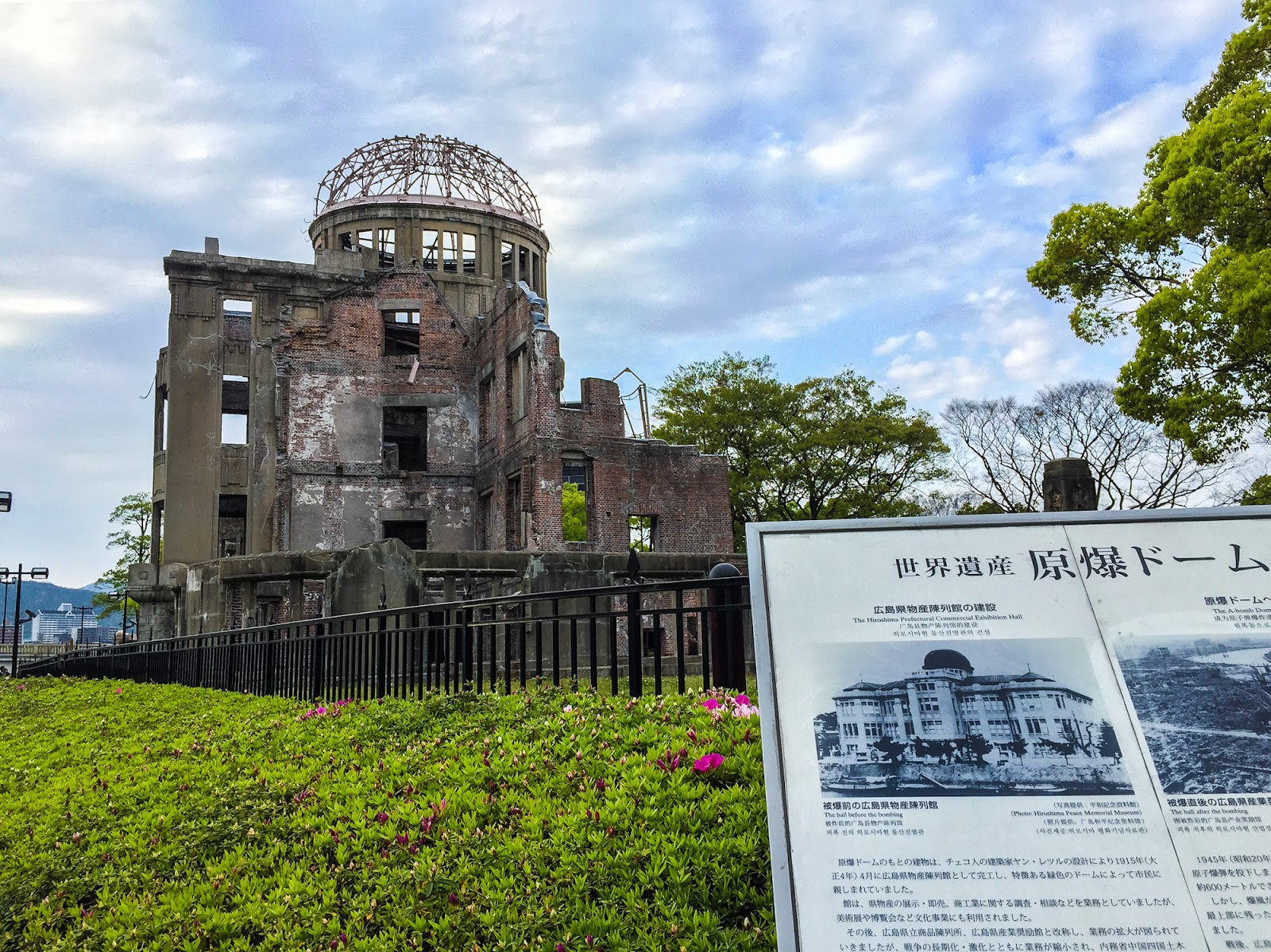
Genbaku Dome. However, there was one building which was partially spared from the blast. The former Hiroshima Prefectural Industrial Promotion Hall, built in 1915, was located just a mere 160 m away from the hypocenter of the atomic bomb withstood the massive forces unleashed by the bomb miraculously. Even though a large portion of the structural steel, including the iconic dome shaped roof remained intact, none of the inhabitants survived from this ordeal. Later renamed as Genbaku Dome or Atomic Bomb Dome (A-Bomb Dome in short), the remains of this building was registered as a UNESCO World Heritage Site in 1996 and served as a constant reminder to mankind on the cruelty of war and nuclear weapons, and the continuous strive to attain lasting world peace. Having been to the Peace Park in Nagasaki city back in 2014 made me want to visit Hiroshima after that and I finally fulfilled this wish on this trip. While walking around Genbaku Dome and Peace Memorial Park, I read about the tragic loss of innocent lives through the signboards with a heavy heart and came to know of the unending pains and sufferings that some people, till today, still have to go through as a result of radiation poisoning.


Peace Memorial Park. Similar to the Peace Park in Nagasaki city, there are a couple of monuments constructed and museums set up in its compound. There were two monuments which I personally like a lot. The first one is Genbaku-no-ko-no-zo 原爆の子の像 otherwise known as Children's Peace Monument. This monument was erected in memory of a young girl named Sadako Sasaki 佐々木貞子 and thousands of children who fell victim to the bombing incident. Sadako Sasaki was only two years old when the nuclear weapon was deployed, and she died 10 years later after being diagnosed with leukemia as a result of radiation poisoning. Built in 1958, a bronze statue of a young girl depicting Sadako Sasaki stood on top of a concrete, arrow shaped monument with a bronze crane hanging within the structure acting as a wind chime. Around the monument, there are glass cabinets containing strings of colourful origami cranes donated by people all over the world, to pray for world peace.


The second one is Genbaku shibotsusha irehi 原爆死没者慰霊碑 or Cenotaph for the A-Bomb Victims. This cenotaph is dedicated to more than 28,000 victims who died from this fateful incident and their names are recorded in a book kept in the stone box which sits in the center of the structure. In my opinion, the location and design of the cenotaph was well thought out. As one stands in front of the cenotaph, he/she will be able to see two important monuments, Heiwa no tomoshibi 平和の灯 or Peace Flame and Genbaku Dome, through the opening of the saddle shaped structure. The Hiroshima Peace Memorial Ceremony is held in the Peace Park on 6 Aug yearly, during which some 50,000 local citizens and visitors, as well as ambassadors and dignitaries from around 70 countries, come together to console the spirits of those killed by the atomic bomb and also to pray for lasting world peace. 

======

Peace Memorial Park 平和記念公園, Genbaku Dome 原爆ドーム
広島県広島市中区大手町1丁目10
Free admission
http://www.city.hiroshima.lg.jp/www/dome/index.html
https://peace-tourism.com/spot/a-bombdome.html
https://www.hiroshima-navi.or.jp/post/006276.html

Museums located within Peace Memorial Park: 

(1) Hiroshima Peace Memorial Museum 広島平和記念資料館
Opening hrs: 0830 - 1800 hrs (Mar - Nov); 0830 - 1900 hrs (Aug); 0830 - 1700 hrs (Dec - Feb)
Admission fee = 200 yen
http://hpmmuseum.jp/


(2) Hiroshima National Peace Memorial Hall for the Atomic Bomb Victims 国立広島原爆死没者追悼平和祈念館
Opening hrs: 0830 - 1800 hrs (Mar - Nov); 0830 - 1900 hrs (Aug); 0830 - 1700 hrs (Dec - Feb)
Free admission
https://www.hiro-tsuitokinenkan.go.jp/


How to get there? 

(1) By Hiroshima Sightseeing Loop Bus Meipuru~pu めいぷる~ぷ.
Take the bus from Shinkansen Exit Platform 2 for Hiroshima Sightseeing Loop Bus Meipuru~pu. The Peace Memorial Park and Genbaku Dome are accessible via all three routes (Orange, Green and Lemon).
Alight at Heiwa Koen mae 平和公園前 or Genbaku Dome mae 原爆ドーム前.

Fare = 200 yen/trip
1 day pass = 400 yen
* Note: For travellers holding on to nationwide Japan Rail Pass, they can board this bus at no additional cost. Ironically, JR West Pass are not accepted on this bus.
Bus schedule: http://chugoku-jrbus.co.jp/teikan/meipurupu/

(2) By Hiroshima Electric Railway 広島電鉄電車 or Hiroden.
From Hiroshima Station, take Streetcar 2 or 6 and alight at Genbaku Dome mae 原爆ドーム前.
Fare = 180 yen
http://www.hiroden.co.jp/train/index.html